
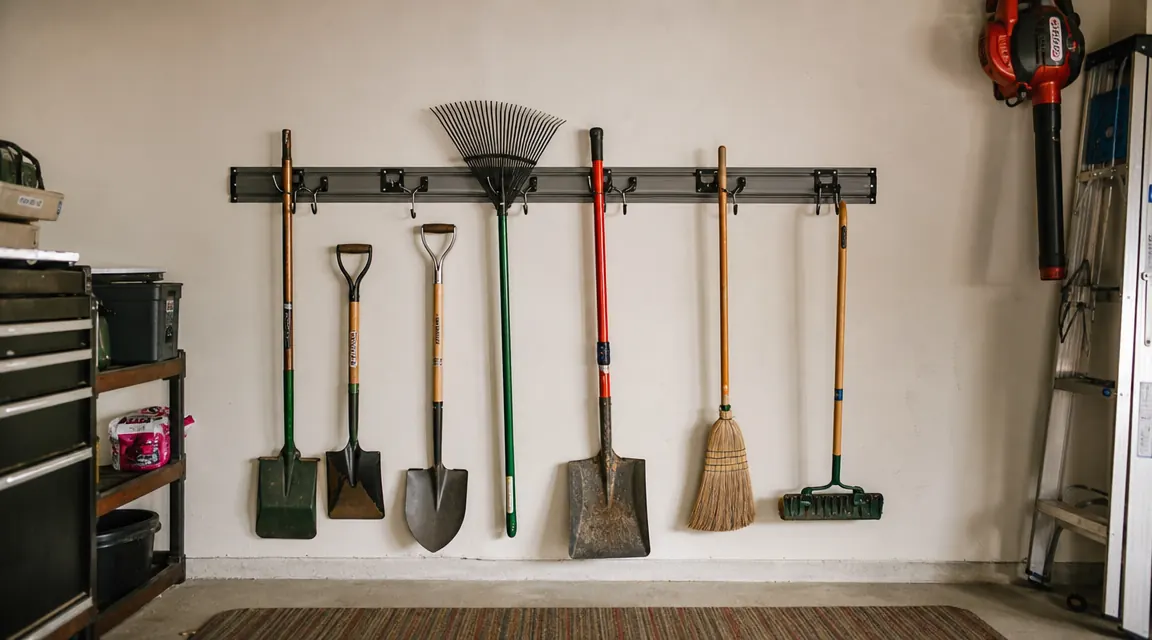
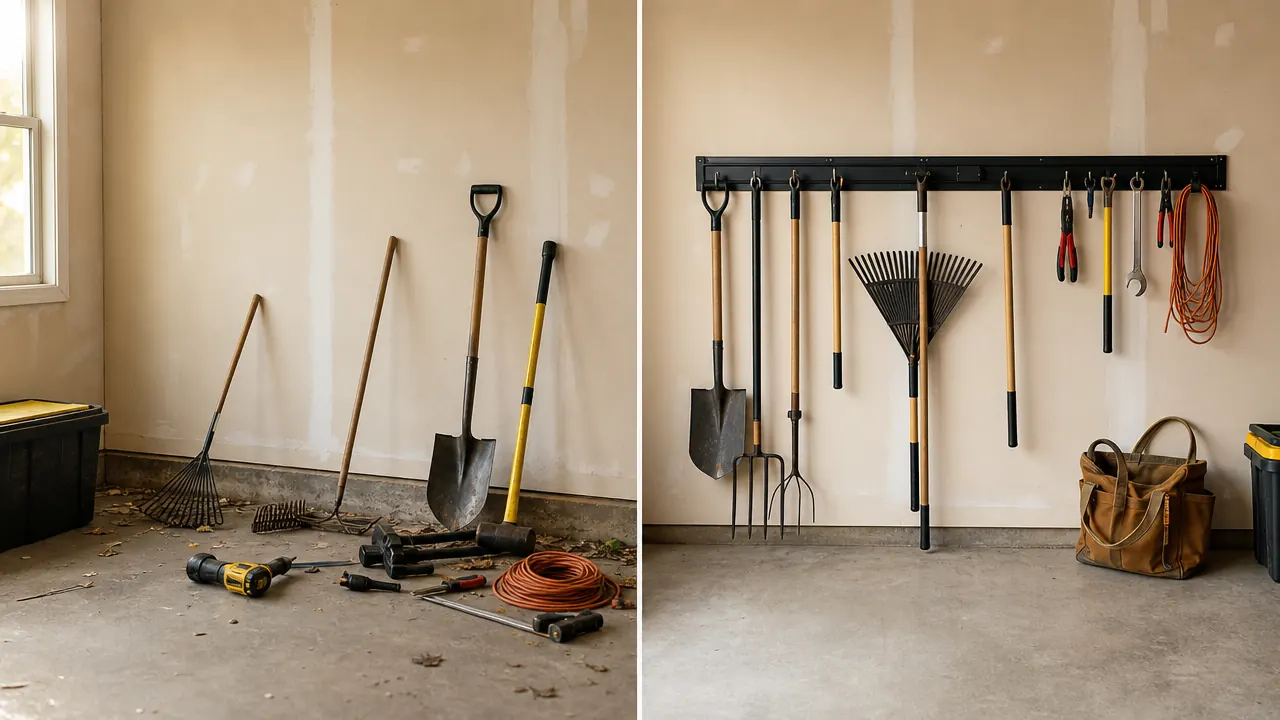
Our garage was the house's dirty secret. Two cars, two kids, one lawn, and eight years of accumulated gear had turned the far wall into a leaning pile of everything: a flat-headed shovel propped against a rake propped against a push broom propped against a broken snow brush I kept meaning to throw out. Every spring I would spend twenty minutes untangling that pile just to find the edger. Then I bought the StoreYourBoard 72-inch Garage Tool Organizer Wall Mount and screwed it into the studs over a rainy weekend last April. A year later, I have not touched that pile because it no longer exists.
I want to be straightforward about what this is. It is a 72-inch powder-coated steel rail with 15 removable hooks. It is not a pegboard system. It is not a full wall panel. It requires drilling into studs. If you are in a rental or have drywall with no studs in the right place, stop reading here and look at something freestanding. If you own your home and have a bare wall with accessible studs, this is probably the best $60 you will spend in your garage this year.
The Quick Verdict
A heavy-gauge steel rail that actually holds a full complement of long-handle tools without sagging, bowing, or pulling away from the wall. The 15 included hooks cover most households. The one real limit: the hooks do not swivel, so oddly shaped tools require some repositioning.
Amazon Check Today's Price →Your garage floor shouldn't be an obstacle course every Saturday morning.
The StoreYourBoard 72-inch wall mount gives you 15 hooks across six feet of steel rail. Fifteen items off your floor. Check current availability and today's price on Amazon.
Amazon Check Today's Price on Amazon →How I Installed It (and Where I Almost Went Wrong)
The box arrived flat-packed: one 72-inch steel rail, a bag of 15 hooks in three sizes, a mounting template on paper, and a set of screws and wall anchors. The instructions are a single folded sheet. They are not complicated, but they do assume you know what a stud finder is. If you do not own one, borrow one or buy the $15 magnetic kind before you start.
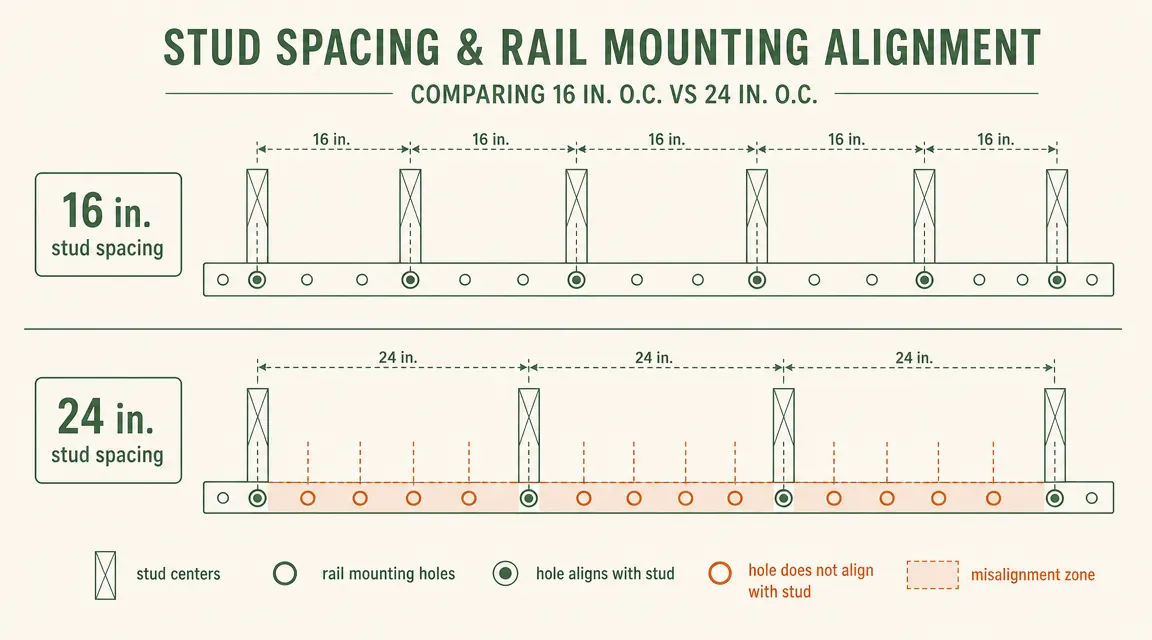
My garage has studs on 16-inch centers, which is standard. The rail has pre-drilled mounting holes spaced to hit either 16-inch or 24-inch stud layouts, which covers almost every residential garage in North America. I found four studs across the 72-inch span and drove the included lag screws into all four. The install took about 45 minutes, including the time I spent hunting for my drill bit set. Once the rail was level and secured, I snapped the hooks on in about three minutes. The whole system felt absolutely solid the moment I hung my first shovel.
The near-mistake: I started by trying to center the rail on the wall using the paper template before I found the studs. Do not do that. Find your studs first, mark them, then position the rail so the pre-drilled holes land on at least three studs. Three is the minimum. Four is better. Two is not enough for a fully loaded rail, regardless of what the box implies.
What the 15 Hooks Actually Hold
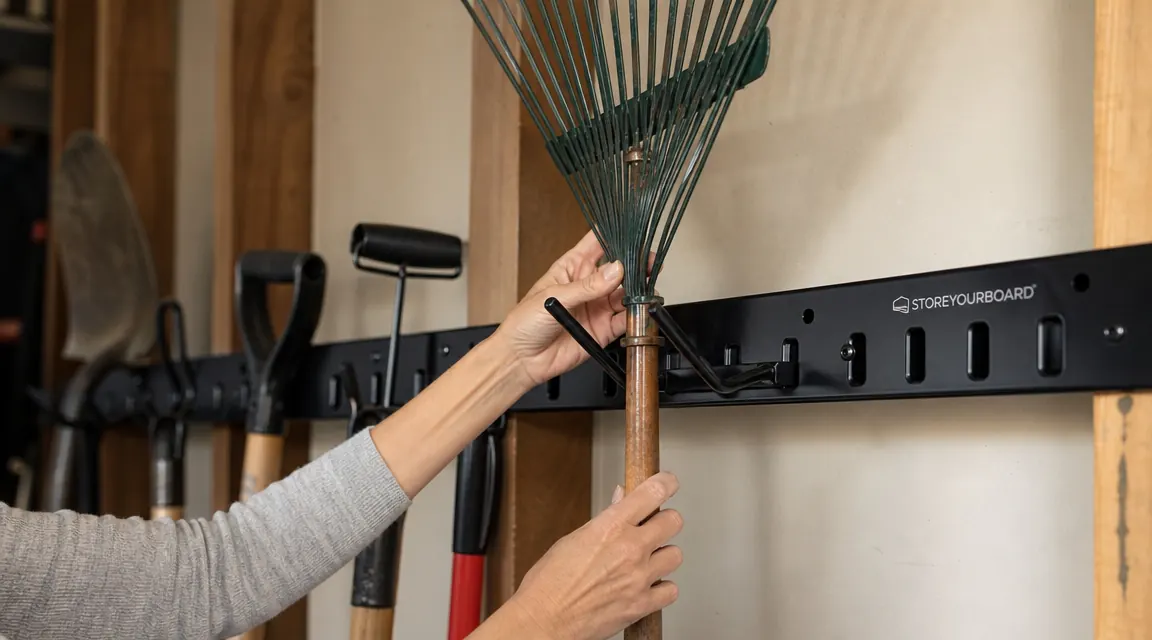
The StoreYourBoard kit includes three hook types. There are large J-hooks for long-handle tools like shovels, rakes, and brooms. There are medium utility hooks with a lip that works well for things like a leaf blower or a coil of garden hose. And there are small closed-loop hooks sized for items like extension cords and small hand tools hung by their handles.
Over the course of a year I have hung the following on this rail simultaneously: a flat-headed shovel, a garden fork, a leaf rake, a push broom, a stiff-bristle broom, a string trimmer, a leaf blower (hung by its handle), two 25-foot extension cords, a 50-foot hose reel, my son's lacrosse stick, my daughter's old softball bat, a snow brush, a bag of ice melt clipped over a hook, and a folded tarp. That is 14 of the 15 hooks in use. The wall holds all of it without the rail moving even slightly.
The weight limit listed is 50 pounds for the full system. I have never weighed everything at once but I am confident we are in that range. Nothing has slipped, nothing has bent, and after 12 months the powder coat on the rail shows only one small scratch where I accidentally dragged a metal rake handle across it.
After 12 months with a fully loaded rail, the steel has not flexed, the hooks have not slipped, and I have not once had to untangle a pile of tools on my garage floor.
Long-Term Durability: Four Seasons in an Unheated Garage
Our garage is unheated. Midwest winters mean the temperature inside drops to single digits in January and climbs back to over 90 degrees in August. A lot of plastic storage gear fails in that temperature swing. The StoreYourBoard rail is powder-coated steel, not plastic, so it handled the swings without any cracking, warping, or flaking. The mounting hardware shows no rust after a year, which suggests the screws included are either coated or at minimum decent zinc-plated steel.
The hooks themselves are the one area where I would push back slightly. They are injection-molded plastic over a steel core. The plastic coating has held up fine on most of them, but the two hooks I use for the heaviest items (the shovel and the garden fork) show minor compression marks in the plastic where the handles rest. The hooks have not cracked and the tools have not fallen, but if I were buying again I would order the all-steel hook upgrade StoreYourBoard sells separately for the three or four hooks carrying the heaviest items.
The Hooks Do Not Swivel, and That Matters
This is the one functional limitation I want to flag clearly. The J-hooks are fixed-angle. They point in one direction. For standard round-handle tools like a broom or a shovel, that is fine. But I have a D-handle garden fork where the D-grip is wider than the hook's opening when approached from the front. I have to tilt the fork sideways to get the handle onto the hook. It takes an extra three seconds. It is not a dealbreaker, but if half your tools have D-handles or T-handles, you will be doing that tilt maneuver constantly. A swivel-head hook design would eliminate this.
The workaround I settled on: I put all the D-handle tools on the medium utility hooks instead of the J-hooks. The utility hooks have a wider opening and a curved lip that clears a D-handle with no tilting required. That reshuffle cost me nothing except five minutes of repositioning on a Sunday morning.
How It Changed the Garage Day-to-Day
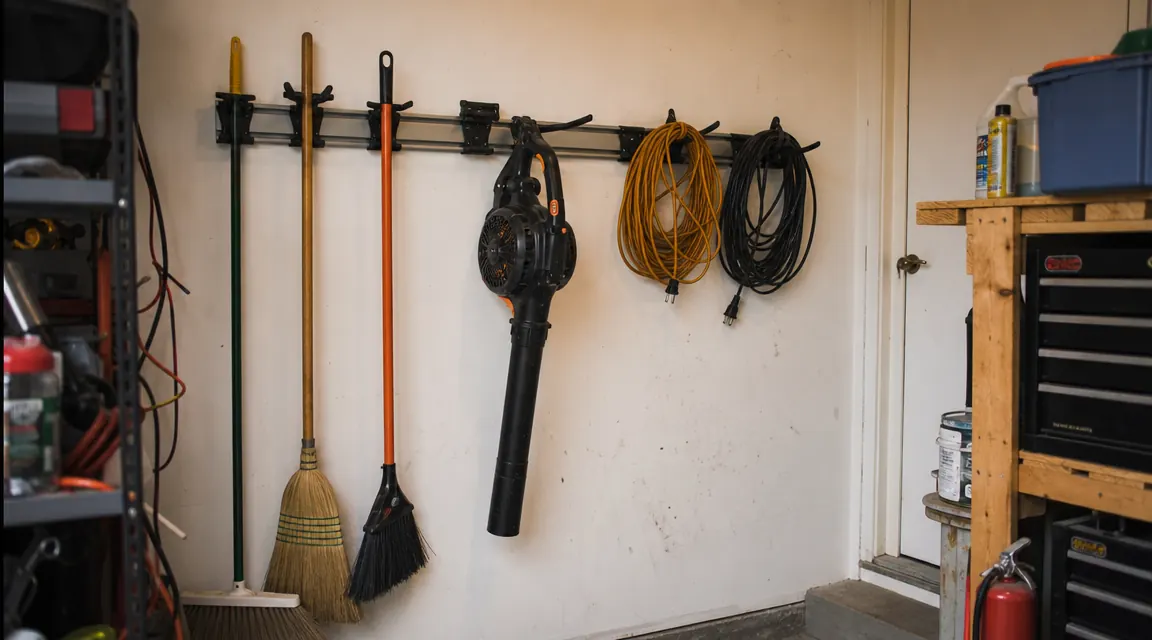
Before this rail, grabbing the edger before mowing meant moving the rake, which knocked over the broom, which revealed the extension cord I had forgotten I owned. Every tool retrieval was a small excavation. Now I walk in, grab the tool from its hook, and walk out. The visual aspect matters too. An organized wall makes it easier to notice when something is missing. I realized last October that my good pruning shears had been sitting in a bucket in the back seat of my car for three weeks, which I never would have noticed before because the wall was always a jumble.
The floor space I reclaimed is roughly 12 square feet. That sounds modest. In a two-car garage that already has two cars, a chest freezer, and a workbench, 12 square feet is the difference between moving sideways past the car and walking normally.
Alternatives I Considered Before Buying
I looked at pegboard panels, the Rubbermaid FastTrack system, a freestanding rack, and a simple pair of metal brackets. Pegboard is versatile but requires a separate panel installation, paint, and a whole set of pegboard-specific hooks. I did not want the project complexity. The Rubbermaid FastTrack is a similar concept but the starter kit costs more and the rail section lengths are shorter, so covering the same wall span requires buying multiple sections and connectors. I compared both in detail in my StoreYourBoard vs Rubbermaid FastTrack comparison if you want the full breakdown. The freestanding rack was eliminated immediately because our floor space was already at a premium. The simple brackets would have worked for two or three tools, not fourteen.
The StoreYourBoard won on simplicity: one rail, screws into studs, done. No panels to cut, no connectors to buy, no floor footprint.
What I Liked
- Heavy-gauge powder-coated steel rail holds its shape fully loaded across all four seasons
- Pre-drilled holes fit standard 16-inch and 24-inch stud spacing without modification
- 15 hooks in three sizes cover a typical household's full tool set
- 72 inches of coverage on a single rail with no connectors needed
- Hooks reposition anywhere along the rail in seconds, no tools required
- Low profile keeps tools close to the wall, does not eat into garage depth
Where It Falls Short
- Requires drilling into studs, not renter-friendly or drywall-anchor suitable for heavy loads
- Fixed-angle J-hooks require a tilt maneuver for D-handle and T-handle tools
- Plastic coating on hooks shows compression marks under sustained heavy loads
- No corner or wrap-around configuration, single straight wall only
Who This Is For
This organizer makes the most sense for homeowners with a garage wall that has accessible studs, at least six feet of clear wall, and more than six long-handle tools currently living on the floor or leaning against things. That describes most single-family homes with a lawn. If your tool collection is genuinely small (a broom and a mop), this is overkill. If you have a large collection and a longer wall, you can buy two rails and mount them end-to-end or stack them vertically. StoreYourBoard sells additional hook sets separately so you are not limited to the original 15.
People with mixed tool types, including both short and long-handle gear, sports equipment, and garden hoses, will get the most out of the varied hook sizes. The three hook types are genuinely different enough to be useful for different categories, not just three versions of the same shape.
Who Should Skip It
Renters, skip it. Even if you have permission to put holes in the wall, the lag screws this system requires leave 3/8-inch holes in the studs. That is not a picture-hook situation. If you are renting and need wall storage, look at tension-rod freestanding solutions or over-door hooks instead. Also skip it if all your tools have non-standard handle shapes, thick D-grips, or very heavy heads (full-size post-hole diggers or heavy splitting mauls sit awkwardly on J-hooks in general). Those items do better on custom brackets or a purpose-built heavy-duty holder. Finally, if you are hoping to store large bins, buckets, or storage boxes, this rail is not designed for it. It is a tool-handle organizer, not a shelf system. For a broader take on what the hooks truly handle, see my StoreYourBoard honest review, which gets into the hook capacity figures in more detail.
Fourteen tools off the floor in one afternoon. That is what six feet of steel rail can do.
The StoreYourBoard 72-inch wall mount is still on our garage wall, still loaded, still solid after a full year. Check today's price and availability on Amazon before it goes out of stock in your size.
Amazon Check Today's Price on Amazon →