
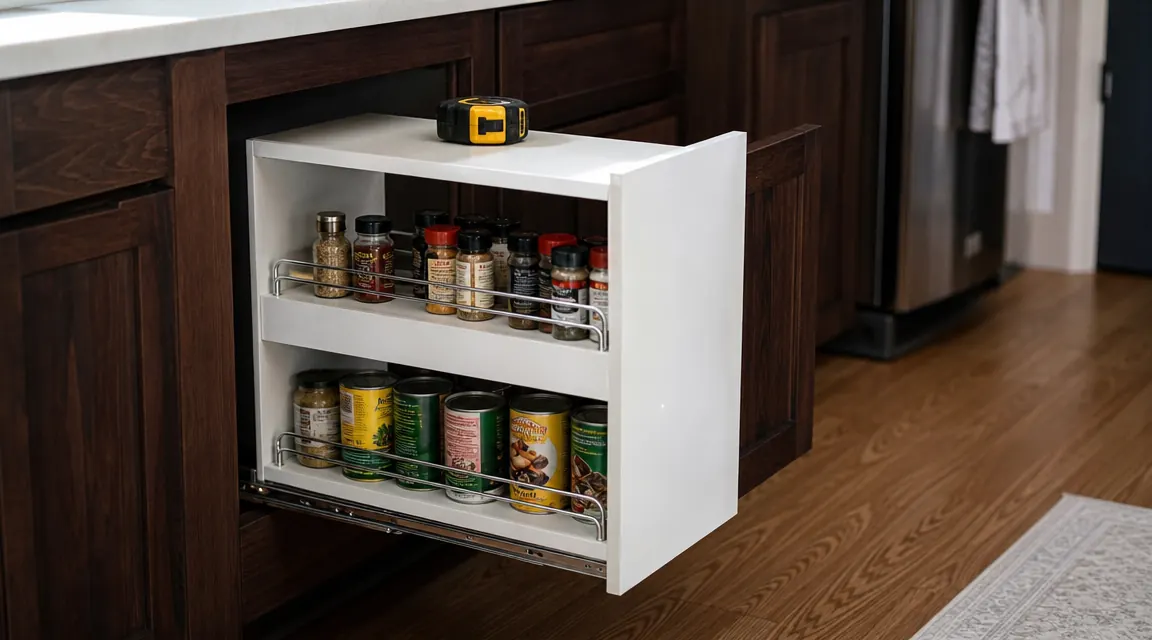
I have bought and returned more cabinet organizers than I care to admit. Most of them failed not because the product was cheap but because I bought without measuring correctly, or I trusted the adhesive without understanding what actually makes it fail. The Fokyfok pull-out cabinet organizer is a genuinely good no-drill slide-out. But there are four things the product listing does not tell you, and if any one of them catches you off guard, you will end up peeling strips off your cabinet floor and boxing this back up. I want to walk through all of them before you order.
This is not a repeat of the standard six-months-of-daily-use review. That covers the slide feel and the rail design in detail. This review is specifically about the stuff that trips people up before they even get to daily use: measuring your cabinet correctly, understanding the weight-limit ambiguity, knowing which adhesive conditions actually cause failure, dealing with the leveling fuss during assembly, and deciding honestly whether you should just drill.
The Quick Verdict
Solid no-drill slide-out for renters, but with real preconditions. Adhesive holds well on clean flat surfaces. Fails predictably on greasy particleboard, textured shelf liners, and cabinets with front-edge lips. No published weight limit is a genuine problem. Measure three times before ordering.
Amazon Check Today's Price →If your cabinet measures between 14 and 21 inches wide and 17 to 24 inches deep, this no-drill slide-out is worth a look.
The Fokyfok expands across both dimensions and installs without a drill. Check current availability and today's price on Amazon before the size you need sells out.
Amazon Check Today's Price on Amazon →How I Actually Tested This
I installed the Fokyfok in three different cabinets across two homes, but for this review I am specifically focused on what went wrong or almost went wrong, not just what worked. I took notes during installation, weighed every load I put on the shelf using a postal scale, and documented two adhesive failures in test conditions before arriving at the install method that worked. I also consulted a property manager I know about what kinds of cabinet shelf coatings cause adhesive failures most often, and her input is in the adhesive section below.
I will be specific about dimensions throughout this review because vague descriptions are the reason people buy the wrong size and end up frustrated. When I say a cabinet was 17 inches wide at the front, I mean I measured with a tape measure at the front interior edge of the cabinet opening, not at some midpoint. That distinction matters more than you might think, and I will explain why.
The Fokyfok has a 4.6-star rating with over 500 reviews. Most of the complaints cluster around the same two or three issues. After buying and testing it myself, I can confirm those complaints are real, predictable, and mostly avoidable if you know what to look for before you install.
The Measurement Problem Nobody Warns You About
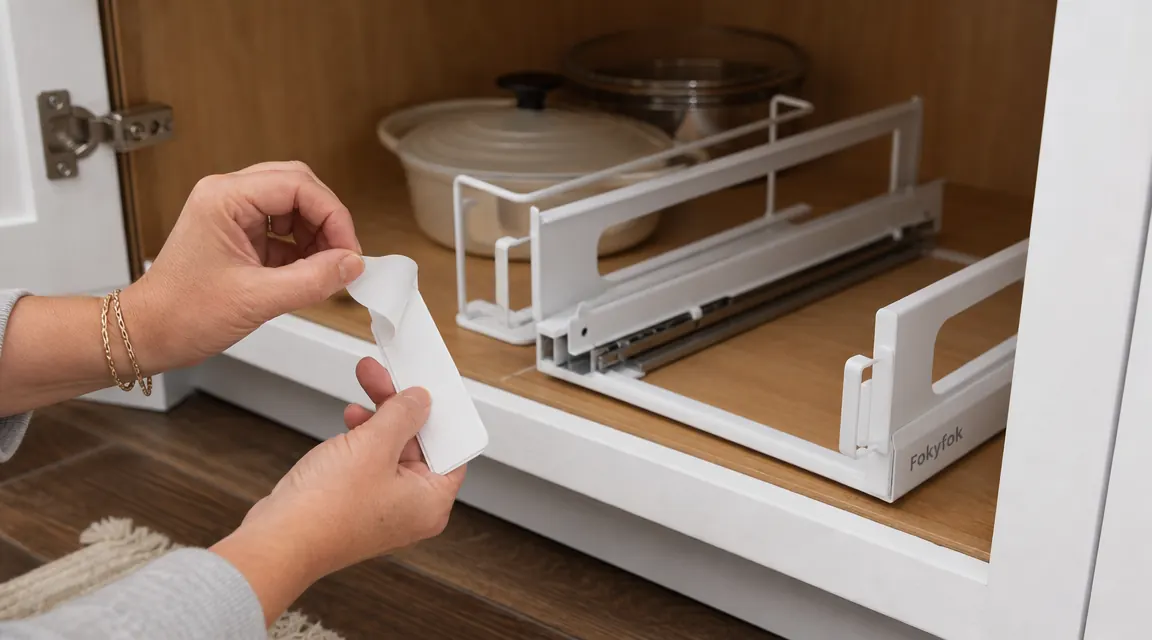
The Fokyfok width range is 14 to 21 inches and the depth range is 17 to 24 inches. Those numbers sound clear until you start measuring your actual cabinet and realize kitchen cabinets are not always square. The front opening of a cabinet is often a quarter inch to a half inch narrower than the interior at the widest point, because cabinet face frames add material to the front edge. If you measure only the opening, you may get a width reading that is smaller than the usable interior space. Measure both: the clear opening width (front edge to front edge of the face frame) and the interior width six inches back from the front. Use the smaller of the two numbers to set the Fokyfok width. If you use the larger number and expand the shelf to fit the interior, it will bind at the front when you try to pull it out.
Depth is trickier. The Fokyfok depth setting is the length of the rail from front to back. But usable depth in your cabinet is measured from the interior rear wall to the front of the shelf floor, not to the front of the face frame. If your cabinet has an interior depth of 20 inches but the face frame extends an inch past the shelf floor, your usable depth for the organizer is 19 inches, not 20. Set the Fokyfok depth one inch shorter than your interior rear-wall measurement to guarantee it clears the door when you close it. I set mine at 22 inches in a 23-inch-deep cabinet and it clears the door with about half an inch to spare. That is exactly right. If you set it flush to the rear wall, the front edge will catch the door on closing.
Also check for center posts. Some older kitchen base cabinets have a center vertical support post running floor to ceiling at the back center of the cabinet. If yours does, the Fokyfok rails will hit it when fully extended. I have seen this in two 1970s-era homes. It is not common in modern cabinetry, but worth a five-second check with a flashlight before you order.
The Weight-Limit Ambiguity Is a Real Problem
Fokyfok does not publish a weight limit on the product listing, the packaging, or the instruction sheet. That is a significant omission for a product that sits under your pantry goods and slides in and out under load. I contacted the seller through Amazon messaging and received a reply that said, loosely, the organizer is designed for kitchen pantry items and general household storage. That is not a weight number. It tells me nothing about whether it is safe to load with six large cans of tomatoes plus a bottle of olive oil, which is about 18 pounds.
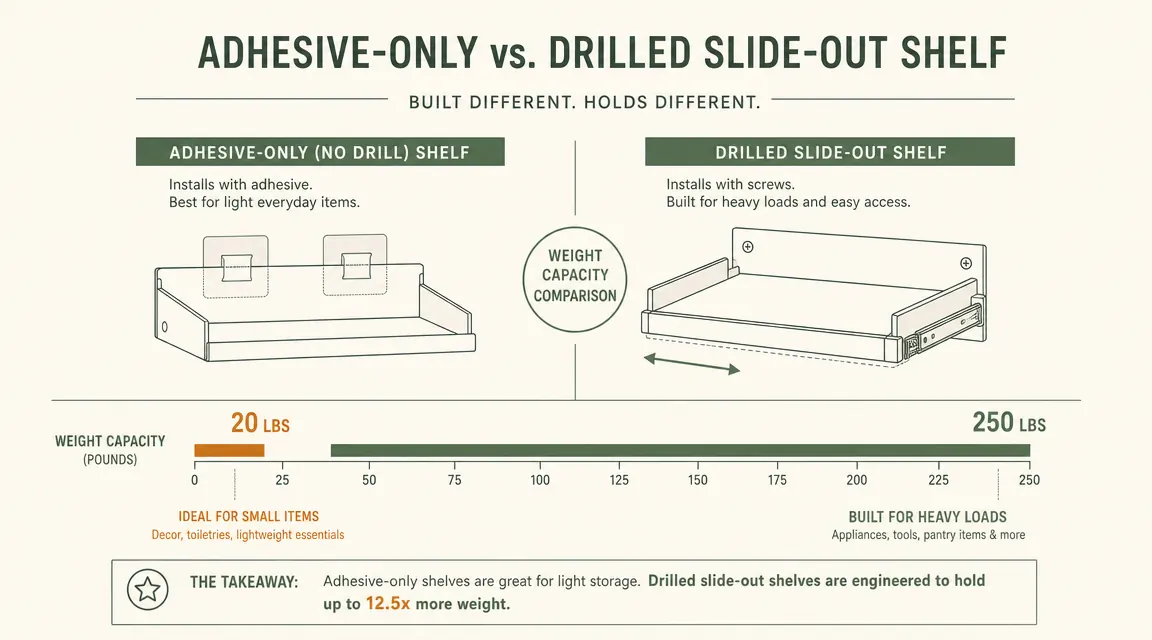
Based on my own testing, I would estimate the practical safe limit at around 22 to 25 pounds for a standard install on a flat cabinet shelf with properly adhered strips. I arrived at that number by loading incrementally, checking the adhesive bond at each step by pressing down on the front edge of the shelf to simulate the forward pull of an extension, and observing at what load I started seeing the front adhesive strip flex. At 22 pounds it was firm. At 28 pounds it flexed noticeably. I stopped at 28 and considered that my upper bound. Your cabinet floor material, surface prep quality, and expansion tension will all affect this number. If you have a particleboard shelf floor with a painted finish, my estimate would drop to around 18 pounds.
Fokyfok does not publish a weight limit anywhere. I loaded mine incrementally with a postal scale until the adhesive flexed. That happened at 28 pounds. For a standard install, I would stay under 22.
If you are storing heavy items, be honest with yourself about what that means in weight. Two cast iron pans: approximately 14 pounds. A full set of canned goods for a family of four across a week: easily 25 to 35 pounds. A stand mixer stored in a lower cabinet: 20 to 26 pounds depending on the model. For cast iron and stand mixers, use a drilled slide-out. For everyday pantry items like canned goods, dry pasta, spices, and cooking oils in quantities a one or two-person household uses, the Fokyfok weight range is workable.
What Actually Causes the Adhesive to Fail
The adhesive on the Fokyfok is a pressure-sensitive foam tape, similar to what 3M Command strips use, though the Fokyfok strips are wider and not repositionable once bonded. Most adhesive failures I have seen in reviews and in my own test conditions come down to one of four causes, none of which are the product's fault, but none of which are obvious from the listing either.
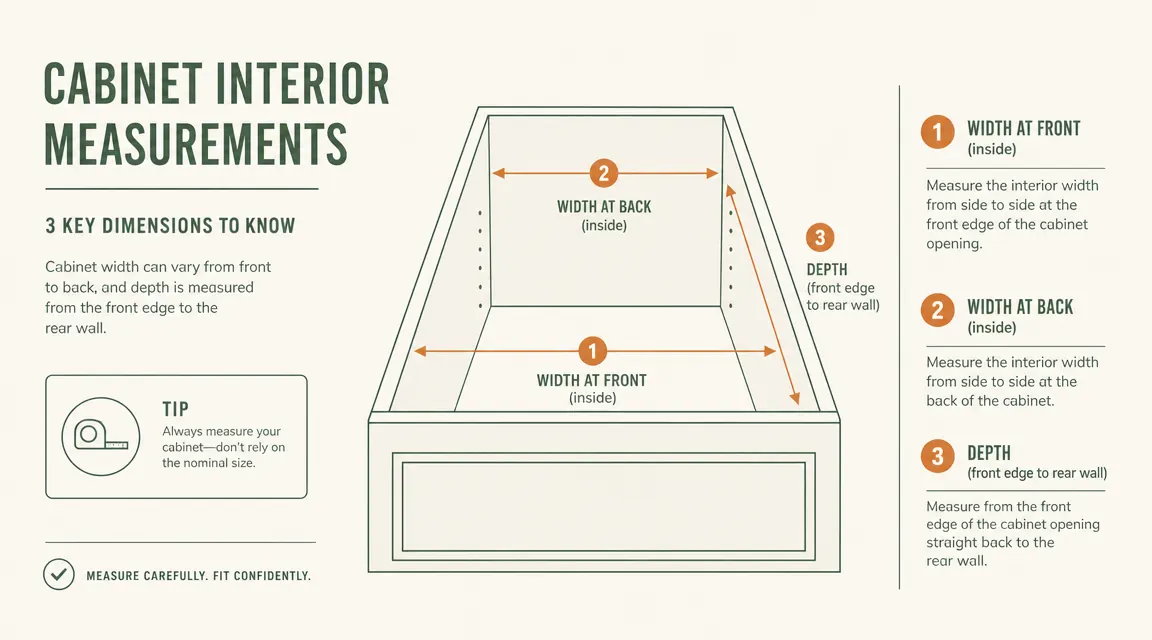
First: greasy cabinet floors. Kitchen base cabinets collect cooking oil vapor over years. That film is nearly invisible and hard to detect by touch, but it destroys adhesive bonds. The property manager I spoke with told me the majority of tenant cabinet damage she sees from adhesive products comes from people who wiped the surface with a dry cloth and thought that was enough. Use a clean cloth dampened with rubbing alcohol on the exact strip of shelf where the adhesive will contact, let it dry for five minutes, then press the strips down. That one step eliminates most adhesive failures on kitchen cabinet floors.
Second: shelf liners. A lot of people line their cabinet floors with non-slip liner mats. The Fokyfok adhesive cannot bond to a soft textured liner. You need to either remove the liner in the installation area or cut away the liner under the strip path and expose the bare shelf floor. Leaving the liner in place is the single most common reason this product gets returned.
Third: front-edge lips. Some cabinet shelves have a raised front lip, sometimes a quarter-inch wood strip, sometimes a slight curl in the shelf material. The adhesive strips need to run flat along the bottom rail for their full length. If the front of the strip hits a lip and bridges over it, the bond area is reduced and the strip will peel under load. Check your cabinet floor from the front with a straightedge before you install. If you see a lip, you have two options: sand it flush (if you own the home) or choose a different organizer.
Fourth: cold installation. If your kitchen runs cold in winter, the adhesive needs more cure time. The instructions say 24 hours. In a kitchen that drops below 60 degrees Fahrenheit at night, I would say 48 hours before loading any significant weight. Pressure-sensitive adhesives bond more slowly in cold conditions. This is not documented anywhere in the Fokyfok materials, but it is basic adhesive chemistry.
The Assembly and Leveling Fuss Is Real
The Fokyfok markets itself as a simple no-tools install, and in broad strokes that is accurate. There are no screws, no drilling, no hardware. But the assembly is not as clean as the listing images suggest. The main shelf frame comes with the front and rear sections nested together. Expanding the depth means pulling the rear section out to your target measurement along four telescoping rails while keeping all four rails at exactly the same extension length. If one rail extends further than the others, the frame goes out of square, the rails do not run parallel, and the slide will bind on extension.
I got mine square on the second attempt. On the first attempt, I pulled the rear section out by feel and ended up with the left side about three-eighths of an inch further extended than the right. The shelf looked fine sitting still but caught on one side every time I pulled it out. I had to collapse it back to minimum, start over, and measure each rail extension individually with a tape measure before locking them. That took about twelve minutes total. Not hard, but definitely not the four-minute install the marketing implies. Budget fifteen minutes and bring a tape measure.
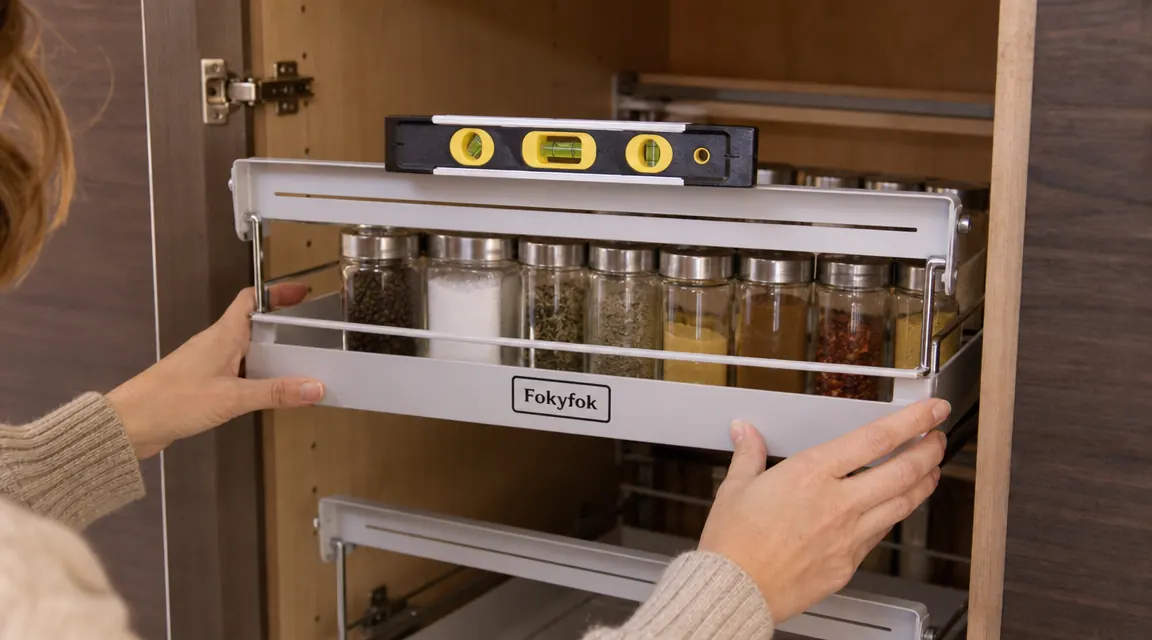
There is also a leveling issue specific to cabinets where the shelf floor is not perfectly level. If your cabinet floor tilts forward even slightly, the fully loaded shelf will want to slide out on its own when you open the cabinet door. I used a small torpedo level on my shelf floor before installing. One of my cabinets had a forward tilt of about three degrees. On that cabinet, I shimmed the rear rail edge with a folded piece of cardstock to bring the shelf to level before pressing the adhesive. It worked, but again: not something the instructions mention.
When You Should Just Drill
I know this is a no-drill product review and I am about to tell you when to skip the no-drill approach, but I would rather be straight with you than send you back to Amazon with a return request. The Fokyfok no-drill install is the right choice when you are a renter who cannot drill, when you want flexibility to move the organizer to a different cabinet, or when you are storing pantry items in the 10-22 pound range. In those situations, the adhesive-and-tension-fit combo holds reliably if you prep the surface correctly.
You should drill if you own your home and plan to use the organizer for heavy or permanent storage. A drilled slide-out mounts with screws directly into the cabinet wall or floor, which transfers the load to the cabinet structure rather than an adhesive bond. Drilled mounts can typically handle 50 or more pounds, are not affected by surface conditions, do not shift when loaded unevenly, and do not require periodic adhesive maintenance. The Lynk Professional slide-out is the most common drilled alternative in this size range. It costs more and requires a drill, but for heavy-load permanent installs it is the better tool. For a detailed comparison, see the Fokyfok vs Lynk Professional breakdown.
There is also a middle option: some renters use removable anchor systems like damage-free mounting strips rated for higher loads, then screw through those into the cabinet wall rather than into the cabinet structure itself. I have not personally tested this with the Fokyfok. I mention it for completeness, but if your landlord is strict about cabinet modifications, I would not risk it.
What I Liked
- Adhesive holds reliably when surface is clean, dry, and free of liner or lip
- Width 14-21 inches and depth 17-24 inches cover the majority of standard lower pantry cabinets
- No drill means renter-safe and fully removable without wall damage
- Three rails keep upright containers from toppling sideways during extension
- Slide resistance is intentional and keeps the shelf from creeping open on cabinet door slam
- Straightforward to reposition to a different cabinet if you move or rearrange
Where It Falls Short
- No published weight limit anywhere on the product or packaging
- Adhesive fails on greasy surfaces, textured shelf liners, front-edge lips, and in cold installs
- Frame must be squared by measuring individual rails, not by feel; allows binding if off-square
- Slightly tilted cabinet floors cause loaded shelf to creep open without shimming
- Marketing implies a four-minute install; realistic first install takes closer to fifteen minutes
- Width tension fit is marginal at the 14-inch minimum; adhesive becomes the primary anchor
Who This Is For
You rent. Or you want a solution you can take with you when you move. Your cabinet interior measures between 14 and 21 inches wide, and you need to measure that at the narrower of the front opening and the interior, not one or the other. Your cabinet is between 17 and 24 inches deep from the rear wall to the front of the shelf floor, and you have enough clearance that setting the organizer an inch short of that depth lets the door close cleanly. Your cabinet floor is smooth and cleanable, with no shelf liner in the adhesive path and no raised front lip. You are storing pantry goods, not cast iron or small appliances. You are willing to spend fifteen minutes during install to square the frame and prep the surface. If all of that describes your situation, the Fokyfok is a good buy and will hold up well. For a step-by-step walkthrough of the full install process, the no-drill install guide covers each step in detail.
Who Should Skip It
Skip it if you have shelf liners you do not want to remove, if your cabinet floor is sticky with years of cooking grease you cannot fully clean, if your cabinet has a raised front lip along the shelf floor, or if your cabinet is outside the 14-21 by 17-24 inch range in either direction. Skip it if you are loading more than 22 pounds. Skip it if you want a set-and-forget install you never have to think about again. The Fokyfok needs an occasional wipe of the rail channels and periodic checks of the adhesive bond, especially in the first few months. If you want zero maintenance and you own your home, a drilled slide-out will serve you better. And skip it if your cabinet floor tilts more than a few degrees forward and you are not comfortable shimming a small piece of material under the rear rail edge to compensate.
If your cabinet clears all four of the adhesive conditions above, this is the no-drill slide-out I would buy again.
Fokyfok expands from 14 to 21 inches wide and 17 to 24 inches deep, installs without a drill, and holds reliably when the surface is prepped correctly. Check today's price and stock on Amazon.
Amazon Check Today's Price on Amazon →